
MMC Training Academy
Ready-Mix Training Simulator
A data-informed VR sandbox pilot for rollover prevention and safer jobsite driving.
Creative Brief and Preliminary Scope | July 2026 | Confidential
Prepared for MMC by ForgeFX Simulations

Working Draft for Scope Alignment
This revision aligns the simulator with MMC’s pilot direction: a free-play VR sandbox focused on safe driving and maneuvering, including jobsite entry, backing with a virtual spotter, calibrated rollover risk, and trainer-led after-action feedback. Concrete pouring is reserved for a future phase.
PAGE
2
01
Purpose of This Brief
MMC Training Academy has identified an opportunity to advance ready-mix driver training through a custom simulation-based solution. This revision confirms a data-informed, free-play pilot focused on safe driving, jobsite entry and backing, vehicle handling, and rollover prevention.
Instead of guided step-by-step lessons, trainees practice and self-assess in a sandbox. The simulator records each run so trainers can review performance afterward and provide focused feedback. Concrete pouring is outside the initial pilot.
02
Training Opportunity
Ready-mix trucks combine a high center of gravity with a rotating, shifting load, limited visibility, changing terrain, and jobsite edges that may not support a loaded vehicle. The study shows that rollover risk is not limited to wet roads or extreme speeds: 88% of surveyed rollovers occurred on dry surfaces, 85% occurred while loaded, and 50% occurred while driving straight.
A VR sandbox can reproduce those risk combinations safely and consistently while trainees choose routes, enter jobsites, turn, back, recover, and learn from the recorded outcome.
MMC Creative Brief
ForgeFX Simulations • Confidential

PAGE
3
03
Core Training Challenge
The highest-priority training issue remains excessive speed combined with abrupt steering or braking.
The NRMCA test truck tipped up at 12 mph in a flat 90-degree turn and rolled at 14-16 mph. In a flat sweeping turn, tip-up began at 25 mph and rollover occurred at 27-29 mph. Sudden steering or hard braking while turning can lower those thresholds.
The sandbox should therefore let driver choices create a progressive, recoverable loss of stability rather than trigger a predetermined animation.
MMC Creative Brief
ForgeFX Simulations • Confidential
04
Recommended Simulator Concept
ForgeFX recommends a custom MMC ready-mix driving sandbox that combines immersive VR, representative driver controls, physics-based loaded vehicle dynamics, a virtual spotter, and performance capture. Trainees choose routes and practice safe entry, turning, backing, and recovery without step-by-step prompts. The pilot does not include chute, discharge, or concrete-pouring workflows; those remain a future phase. The mobile, fixed-base system models steering, braking, traction, axle pressure, road geometry, and ground support, then records each run for trainee self-assessment and trainer-led debriefing.
PAGE
4
05
Rollover Study Evidence
The NRMCA survey and case investigations establish the risk profile that the pilot should reproduce. The evidence points to loaded trucks, moderate-speed turns, dry roads, and jobsite support loss - not only extreme weather or high-speed events.
Source: NRMCA Rollover Prevention Program Student Handout.
MMC Creative Brief
ForgeFX Simulations • Confidential
| Study evidence | Simulator implication |
1 | 136 rollovers / 42 companies | Model recurring, documented failure modes |
2 | 52% involved injuries | Use safe failure and corrective practice |
3 | 2% involved fatalities | Treat rollover prevention as high consequence |
4 | 85% occurred while loaded | Use a loaded mixer as the pilot baseline |
5 | 88% occurred on dry surfaces | Prioritize speed, geometry, and support loss |
6 | 70% of turning rollovers were right turns | Include right-turn and ramp/intersection risks |
7 | 50% occurred while driving straight | Include edges, slopes, shoulders, and voids |
PAGE
5
06
Physics Model
The simulator should calculate rollover risk continuously rather than trigger a canned animation. The 65,000 lb Madras test truck provides the initial calibration reference.
The model should represent the mixer truck's high center of gravity; load state; drum rotation and speed; side-to-side and front-to-back concrete movement; suspension and tire contact; steering rate; braking and throttle; trailer-axle pressure; and the effect of road bank, grade, cross-slope, uneven pavement, and soft or unsupported ground.
MMC Creative Brief
ForgeFX Simulations • Confidential
07
Rollover State Mechanics
The vehicle should move through four physics-driven states: (1) Stable - all wheels supported with a safe stability margin; (2) Warning / tip-up - rising roll angle, traction change, wheel unloading, and clear visual, audio, and steering cues; (3) Recoverable instability - the trainee can straighten or steer away from the turn, reduce speed, regain control, and then brake; and (4) Rollover failure - wheel lift persists, the center of mass crosses the support boundary, or the terrain/edge no longer supports the vehicle.
This approach lets the same scenario produce a safe pass, a successful recovery, or a rollover based on the driver's actions.
PAGE
6
08
Calibrated Trigger Conditions
Measured thresholds from the Madras, Oregon testing should seed the loaded-truck model. They are calibration anchors, not universal constants: load, bank direction, grade, axle pressure, pavement, steering rate, and braking should move the threshold dynamically.
Source: NRMCA research testing with a 65,000 lb mixer truck.
MMC Creative Brief
ForgeFX Simulations • Confidential
| Condition | Calibration / failure logic |
1 | Flat 90° turn | Tip-up at 12 mph; rollover at 14-16 mph |
2 | Flat sweeping turn | Tip-up at 25 mph; rollover at 27-29 mph |
3 | Abrupt steering in a turn | Increase lateral transfer and lower threshold |
4 | Hard braking in a turn | Shift load abruptly and lower threshold |
5 | Banked or cross-sloped turn | Raise or lower threshold by bank direction |
6 | Uneven pavement | Unload wheels and reduce stability margin |
7 | Overpressurized trailer axle | Reduce drive-tire traction and threshold |
PAGE
7
09
Jobsite Rollover Scenarios
Jobsite sandbox scenarios should focus on loaded trucks entering, maneuvering, and backing at unsafe speed or on unsuitable ground. Trainees choose the route and approach without prompts; each run can progress from warning cues to recovery or rollover failure. Pouring is excluded.
MMC Creative Brief
ForgeFX Simulations • Confidential
| Jobsite scenario | Failure / learning condition |
1 | Unsupported access road | Loaded entry near 15 mph + drift + over-correction |
2 | Backing with virtual spotter | Mirror-visible NPC uses nine hand signals; trainee must respond and stop if sight is lost |
3 | Excavation edge | Ground gives way or setback is under 1 ft per foot of depth |
4 | Hidden void / soft soil | Rear tire enters a septic tank, void, or weak ground |
5 | Wrong entrance / trench | Unsafe route brings tires near a 3-4 ft trench |
6 | Steep grade | Front wheels unload; braking or rollback adds instability |
7 | Soft shoulder | Rear tires lose support; abrupt correction triggers roll |
PAGE
8
10
Pilot Scope Options
All options use one representative MMC-style loaded mixer and a common fixed-base VR driving sandbox. Safe entry, backing, vehicle handling, the nine-signal spotter, score/replay, and trainer review are common. Pouring is a future phase.
Recommended proposal structure:
MMC Creative Brief
ForgeFX Simulations • Confidential
| Scope option | Included capability |
1 | Option 1: Driving Sandbox | Free-play entry, turning, backing, spotter NPC, vehicle handling, and score/replay |
2 | Option 2: Rollover Sandbox | Recommended: rollover physics, four risks, and wreck/fail debrief |
3 | Option 3: Expanded Jobsite Risk Sandbox | Adds all seven risks, configurable terrain, and advanced backing/spotter variations |
4 | Optional physical upgrades | Seatbelt sensor, force feedback, and haptics; motion cues remain optional |
5 | Future content phase | Add mixer controls, chute positioning, discharge, and concrete pouring |
11
Selection Considerations
| Decision factor | Proposal treatment |
1 | Schedule and budget | Price each sandbox option and show incremental effort |
2 | Training value | Option 2 best aligns with the supplied study and pilot goals |
3 | Comfort and hardware | Pilot uses simple failure feedback; enhanced sensory effects are future |
4 | Validation | Confirm free-play design and nine hand signals with MMC trainers |
PAGE
9
12
Common Pilot Foundation
Every pilot option begins with one representative MMC-style ready-mix truck and a common free-play driving foundation. Trainees practice without step-by-step prompts, self-assess after each run, and review recorded performance with a trainer. Pouring is not included.
The common foundation includes:
MMC Creative Brief
ForgeFX Simulations • Confidential
| Module | Purpose |
1 | VR Orientation | Introduce comfort, free-play navigation, and simulator controls |
2 | Driver Controls | Familiarize steering, braking, throttle, transmission, and mirrors |
3 | Loaded Vehicle Dynamics | Model mass, rotating load, traction, and weight transfer |
4 | Jobsite Entry and Backing | Practice route choice, positioning, clearance, and spotter signals |
5 | Tip-Up / Recovery / Failure | Recognize warning cues, recover, or receive immediate failure feedback |
6 | Scoring, Replay, and Trainer Review | Capture inputs, signals, stability, and outcome for self/trainer review |
PAGE
10
13
Flagship Rollover Scenario
MMC Creative Brief
ForgeFX Simulations • Confidential
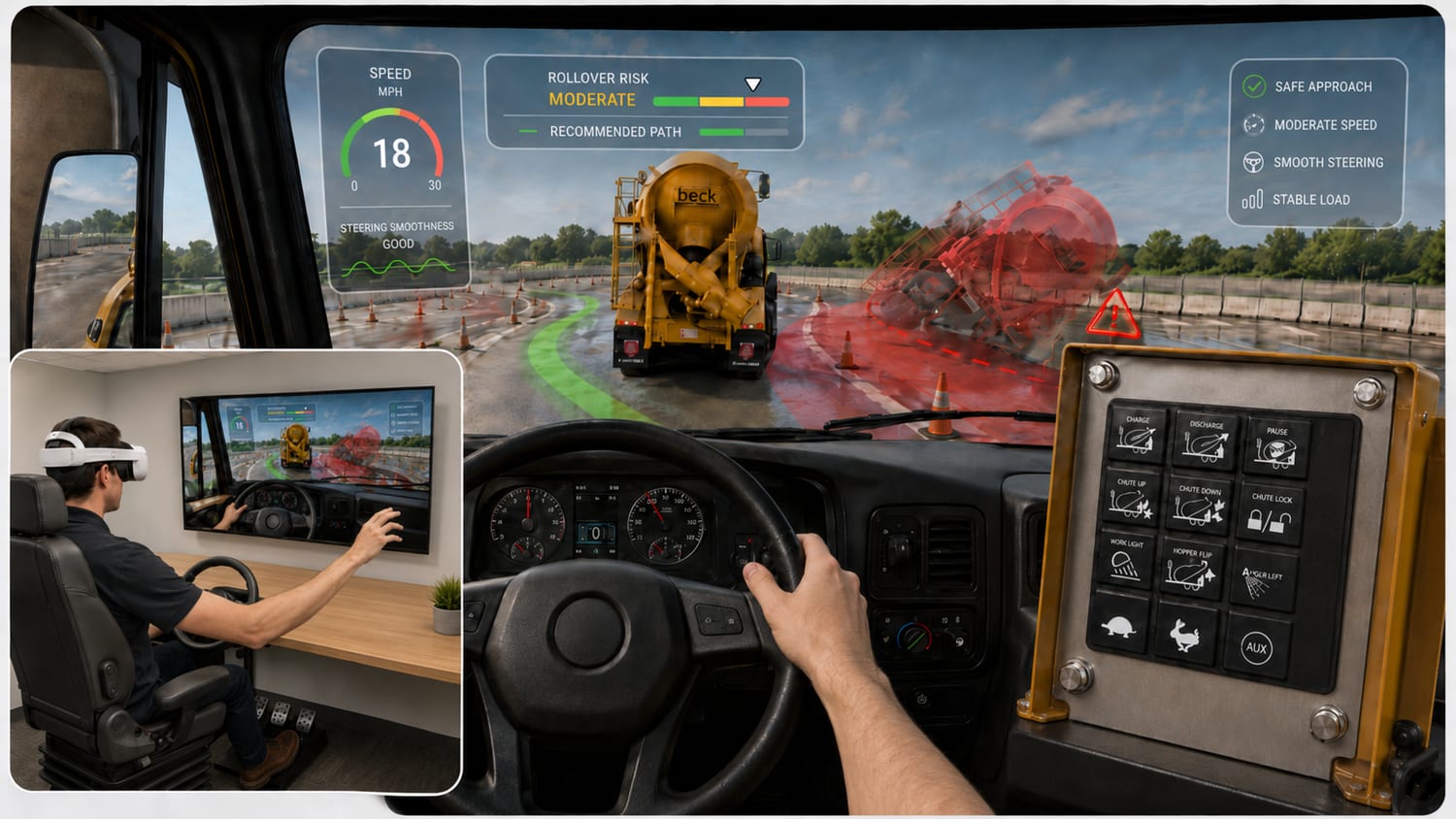
The flagship free-play scenario combines measured turn thresholds with loaded jobsite entry, route choice, and spotter-guided backing.
Without step-by-step prompts, the trainee selects an approach, completes a right turn near uneven or soft ground, then backs into position using the mirror-visible NPC’s nine-signal vocabulary. The simulator evaluates speed, steering, braking, rear-tandem path, signal recognition, spotter visibility, and stability margin.
The run ends with safe positioning, a successful recovery, or rollover failure. Pouring is not performed.
Flagship scenario: loaded jobsite entry, calibrated turn risk, nine-signal spotter backing, and trainer-reviewed replay. Concept image shown; pilot hardware uses driving controls only.
PAGE
11
14
Virtual Spotter and Hand Signals
During backing, a virtual spotter appears where a real spotter should be visible in the rear-view mirror and communicates through the approved nine-image Ready Mix hand-signal standard.
The trainee must maintain visual contact, recognize the signal, respond correctly, and stop immediately if the spotter is no longer visible. Performance capture records the signal shown, response, reaction time, path, clearance, and any unsafe continuation. MMC trainers review the replay after the run and provide coaching.
MMC Creative Brief
ForgeFX Simulations • Confidential
15
Driving and Maneuvering Scope
The pilot is limited to safe driving, loaded jobsite entry and backing, route choice, clearance management, vehicle handling, rollover recognition, and recovery.
It does not initially include chute positioning, discharge, or concrete pouring. Those mixer and pouring workflows remain a future phase built on the same vehicle, jobsite, and performance-measurement foundation.
PAGE
12
16
Hardware and Mobility Direction
The pilot remains a compact, mobile, fixed-base station that can move between MMC locations. Physical platform rotation and mixer-control hardware are not required. The pilot communicates rollover through vehicle physics, VR visuals, audio, and direct failure messaging; richer motion, haptic, and disorientation effects can be evaluated later.
MMC Creative Brief
ForgeFX Simulations • Confidential
| Component | Role |
1 | PC VR system / headset | Renders cab, mirrors, road, jobsite, and spotter |
2 | Truck-style seat + seatbelt | Provides realistic posture, restraint cue, and optional sensor |
3 | Steering wheel and pedals | Captures steering, braking, throttle, and recovery inputs |
4 | Mirror / spotter view | Supports rear-view hand-signal communication during backing |
5 | Fixed-base feedback | Uses visual/audio cues and simple pilot-stage failure messaging |
17
Training Audiences
The simulator supports four high-value MMC Training Academy audiences:
| Audience | Value |
1 | New Drivers | Build risk recognition before live equipment |
2 | Driver Trainers | Deliver consistent scenarios and coaching |
3 | Post-Incident Drivers | Target remediation after unsafe behavior |
4 | Experienced Drivers | Refresh high-risk skills and recovery technique |
PAGE
13
18
Performance Measurement
The simulator should capture decisions and vehicle behavior during free play without turning the experience into a guided lesson. Natural vehicle and safety cues support recovery. After the run, replay supports trainee self-assessment and trainer-led feedback.
Core performance metrics:
MMC Creative Brief
ForgeFX Simulations • Confidential
| Metric | Training value |
1 | Entry / turn speed and threshold margin | Shows proximity to calibrated warning and failure limits |
2 | Steering rate, jerk, and reversals | Identifies abrupt input and over-correction |
3 | Brake / throttle timing | Reinforces smooth sequencing and control |
4 | Spotter signal recognition and reaction | Measures correct interpretation and timely response |
5 | Mirror contact and stop compliance | Flags unsafe backing after the spotter is lost |
6 | Rear-tandem path and edge clearance | Measures support margin near shoulders and trenches |
7 | Stability, recovery, and run outcome | Supports self-assessment, trainer review, and remediation |
PAGE
14
19
Rollover Failure Feedback: Pilot and Future
MMC Creative Brief
ForgeFX Simulations • Confidential
Critical errors must end the run immediately and unambiguously.
Pilot baseline: when the rollover threshold is crossed, freeze or fade the scene and display “YOU WRECKED — SCENARIO FAILED.” Then show a replay of speed, threshold margin, steering, braking, roll angle, wheel lift, and terrain support. The trainee self-assesses first; the trainer then reviews and coaches.
Future enhanced tier: add realistic sound, motion cues, haptics, visual disorientation, and a comfort-managed roll only after MMC validates learning value and user comfort.
Design principle: make failure immediate and memorable in the pilot, then add sensory realism only when it improves learning safely.
PAGE
15
20
Long-Term Expansion Potential
The pilot establishes a validated loaded-mixer physics and scenario foundation that can expand after MMC selects and evaluates the initial scope.
Potential future additions:
MMC Creative Brief
ForgeFX Simulations • Confidential
| Expansion area | Description |
1 | Additional jobsite environments | Add tighter access, more spotter variations, obstacles, and customer sites |
2 | Load, drum, and axle variants | Vary load state, drum speed, and trailer-axle pressure |
3 | Weather and road geometry | Add wet/ice, banks, ramps, rural roads, and hills |
4 | Pouring and mixer operations | Add chute positioning, discharge, pour sequencing, and mixer controls |
5 | Additional truck configurations | Represent more MMC fleet variations over time |
6 | LMS and instructor dashboard | Centralize records, replay, progress, and remediation |
7 | Enhanced sensory feedback | Add richer sound, motion cues, haptics, and disorientation effects |
PAGE
16
21
Why This Matters
In the NRMCA survey, 52% of documented rollovers involved injuries and 2% involved fatalities. Among fifteen investigated cases, nine drivers were injured, one fatally; a member of the public was severely injured; and estimated company costs were at least $2,775,000.
Simulation lets MMC recreate the decisions and vehicle behavior behind these incidents without exposing trainees, equipment, or the public to the real consequence.
For MMC, this creates value in six ways:
MMC Creative Brief
ForgeFX Simulations • Confidential
| Value area | Benefit |
1 | Safety | Practice high-consequence decisions without live exposure |
2 | Consequence | Make rollover risk visible, felt, and memorable |
3 | Consistency | Deliver the same sandbox conditions and scoring across trainers |
4 | Remediation | Let trainers review the exact run and coach the behavior that created risk |
5 | Scalability | Train more drivers without tying up a mixer truck |
6 | Leadership | Give MMC a data-backed ready-mix safety platform |
PAGE
17
22
Recommended Next Step
ForgeFX recommends moving into a formal proposal phase built around the three driving-sandbox options in this brief.
Proposal contents:
MMC Creative Brief
ForgeFX Simulations • Confidential
| Proposal item | Description |
1 | Scope selection | Price Options 1-3 and their incremental jobsite and rollover capability |
2 | Physics validation | Validate loaded-truck thresholds with MMC fleet data and trainers |
3 | Sandbox scenario definition | Confirm free-play entry/backing tasks, boundaries, and end states |
4 | Spotter and failure feedback | Validate nine signals, mirror placement, scoring, and wreck/fail message |
5 | Schedule and cost | Price and schedule each driving-sandbox option |
6 | Expansion path | Plan later pouring, environments, LMS tools, and sensory upgrades |
PAGE
18
23
Conclusion
The supplied rollover data confirms the physics approach, while MMC’s pilot direction confirms the training approach: a free-play, driving-only sandbox in which loaded-truck dynamics, terrain, driver inputs, and spotter communication determine the outcome.
The pilot should concentrate on safe entry, turning, backing, clearance, vehicle handling, tip-up recognition, and recovery. A mirror-visible NPC should use the approved nine-image Ready Mix hand-signal standard. When a critical rollover occurs, the pilot should stop the run, state “YOU WRECKED — SCENARIO FAILED,” and move directly to trainee self-assessment and trainer-led replay.
Pouring operations and richer sound, motion, haptic, and disorientation effects remain future phases that build on the same validated platform.
MMC Creative Brief
ForgeFX Simulations • Confidential
PAGE
19
24 Scope & Cost Options
MMC Ready-Mix Training Simulator
ForgeFX Simulations • Confidential
Three scope options price the driving-sandbox pilot described in this brief. Option A is deliberately held under $100,000 so MMC can start small; Option B adds the production asset package, the controls and physics system, and assessment reporting; Option C adds the expanded scenario library, deployment tooling, and an analytics support allowance.
Pricing status — internal draft. These figures come from the MMC cost workbook, which carries the note “DRAFT generated from live Salesforce Proposal Due status for internal skill examples. Not approved pricing.” The row names also predate this brief’s Option 1–3 sandbox structure. Treat both as a starting point for the proposal phase, not a quote.
| # | Feature Title | Feature Description | Option A Baby Bear |
Option B Mama Bear |
Option C Papa Bear |
|---|---|---|---|---|---|
| 1 | ForgeSIM Framework | MMC Materials simulator foundation, session flow, menus, audio, tracking, and launch shell. | $20,000 | $20,000 | $20,000 |
| 2 | Core Training Scenario | A complete ready-mix operations training scenario for ready-mix operators, with goals, prompts, scoring, and review. | $22,000 | $22,000 | $22,000 |
| 3 | Prototype Interaction Set | A first-pass ready-mix simulator interaction package with core controls and stakeholder review path. | $24,500 | $24,500 | $24,500 |
| 4 | Minimum Deployment Package | A shippable ready-mix simulator pilot package with QA, installation notes, and handoff support. | $28,000 | $28,000 | $28,000 |
| 5 | Production Asset Package | Production-ready plant, truck, dispatch, safety, and jobsite workflow scenarios, representative visuals, states, and content review. | — | $46,000 | $46,000 |
| 6 | Controls and Physics System | The primary ready-mix truck and plant workflow control model, operating states, feedback, and error conditions. | — | $52,000 | $52,000 |
| 7 | Assessment Reporting Workflow | Trainee scoring, session records, instructor review, exports, and manager reporting views. | — | $43,000 | $43,000 |
| 8 | Expanded Scenario Library | Additional normal, hazard, edge-case, remediation, and repeat-practice scenarios. | — | — | $58,000 |
| 9 | Admin and Deployment Tools | Admin configuration, deployment package, user documentation, and support handoff materials. | — | — | $39,000 |
| 10 | Analytics Support Allowance | Advanced analytics, content-update allowance, warranty correction, and roadmap support. | — | — | $47,000 |
| TOTAL | $94,500 | $235,500 | $379,500 | ||
Option A holds rows 1–4 only, intentionally below $100,000. Option B covers rows 1–7. Option C covers rows 1–10. Source: MMC-Materials_MMC-Cement-Truck-Driving-Simulator_Cost-Table.xlsx, Salesforce opportunity 006Uh00000lrbrBIAQ, proposal due 2026-07-22.
PAGE
20
25 Let’s Get Started
MMC Ready-Mix Training Simulator
ForgeFX Simulations • Confidential
ForgeFX Simulations looks forward to helping MMC Materials turn this brief into a priced proposal. The next step is a short scope-selection pass: confirm which of the three driving-sandbox options MMC wants priced, validate the loaded-truck rollover thresholds against MMC fleet data, and confirm the nine-signal spotter vocabulary with MMC trainers.
Once that is settled, ForgeFX will issue a formal proposal with a schedule, a firm cost per option, and an expansion path covering pouring operations, additional environments, LMS integration, and enhanced sensory feedback.
Mary Pierce
Executive Director of Enterprise Partnerships
(415) 788-5725, ext. 703
[email protected]
ForgeFX Simulations
2109 N Street, Suite N
Sacramento, CA 95816
www.forgefx.com