


Consistent Readiness Takes More Than Classroom Instruction
Outokumpu’s crane training challenge is not a lack of procedures, experienced trainers, or operator commitment. The challenge is giving new and cross-training operators enough safe, consistent, hands-on practice before they begin working with live equipment, suspended loads, production activity, and changing floor conditions.
Overhead crane operation requires trainees to connect several skills at once: belly box control, load movement, body position, line of sight, travel-path awareness, communication, hazard recognition, and stop-condition judgment. These skills are difficult to build through classroom instruction alone and difficult to repeat consistently during live-floor training.
Live equipment training is valuable, but it cannot easily be paused, reset, repeated, or standardized. Trainers cannot deliberately create pedestrian conflicts, visibility issues, improper coil engagement, excessive load swing, or other unsafe conditions just to see how a trainee will respond. As a result, some of the most important readiness behaviors are learned under real production pressure.
During periods of rapid hiring or cross-training, the challenge becomes even greater. Trainers must prepare more employees while maintaining the same level of training quality across people, shifts, departments, and locations. Without sufficient structured repetition, trainees may reach the floor with uneven control habits and a lack of confidence due to limited exposure to the situations they are expected to manage safely.
The core training gap is repeatable practice at scale: giving every operator enough consistent, realistic training time before the first live lift.
- Project Overview
- Executive Summary
- Simulator Features
- Training Modes and Performance Progression
- Experiencing the Pilot
- Phase Overview
- Cost Table
- Conclusion
Building Crane-Operator Readiness Before Live-Floor Exposure
Outokumpu’s overhead crane operators work in an active steel-production environment where safe coil movement depends on more than basic equipment control. Operators must understand the production floor, anticipate surrounding activity, manage suspended loads, and make disciplined decisions while working around people, equipment, restricted areas, and ongoing line-side operations.
Current training relies on classroom instruction, trainer-led observation, and supervised experience with live equipment. That progression remains essential, but it offers limited opportunity for new or cross-training operators to repeat difficult procedures, experience changing conditions, or build confidence before entering a live production setting.
ForgeFX proposes a Crane Operator Training Simulator that gives Outokumpu a realistic, repeatable bridge between classroom learning and live-floor operation. Under the recommended Phase 2 Pilot, the simulator will use a standalone VR headset, an HBC Spectrum B belly box controller, and a mirrored instructor view. The simulator allows trainees to practice representative crane and coil-handling tasks with coaching and performance feedback, without placing personnel, equipment, or production material at risk.
The initial pilot is designed to help Outokumpu evaluate whether simulation can improve operator readiness, reinforce consistent training expectations, and provide trainers with clearer insight into performance before trainees advance to supervised live-equipment instruction.
ForgeFX Simulations proposes a phased approach to developing the Outokumpu Crane Operator Training Simulator, allowing Outokumpu to select the level of investment, training depth, and long-term scalability that best align with its current goals.
Each option builds from the same core training priority: helping operators practice crane-control decisions, coil-handling behaviors, and safety-critical actions in a repeatable virtual environment before progressing to live-floor operation. The proposed options range from a focused proof-of-concept application to a broader crane and material-handling training platform.
ForgeFX recommends the Pilot Option as the strongest balance of training value, demonstration impact, and practical scope for the first release. It provides a more complete operator readiness experience than the Proof of Concept while remaining focused enough to support efficient development, stakeholder evaluation, and future expansion.
This approach gives Outokumpu a credible first release for safety, management, and trainer review, while preserving a clear path toward a broader crane and material-handling training program.
Concept
Immersive Audio and Guided Instruction
The Pilot Option will include immersive audio and guided instruction to help trainees understand the virtual worksite, recognize equipment response, and follow the coil-handling exercise with clear support. The simulator will combine ambient facility audio, equipment-specific cues, professional narration, and synchronized on-screen guidance so operators receive feedback through both what they see and what they hear.
Immersive environment audio will help recreate the atmosphere of an active steel-production setting. Ambient sounds may include ventilation, machinery, warning signals, distant facility activity, and nearby equipment movement. These sounds reinforce the scale and activity of the workspace while making the virtual environment feel more operationally credible.
Equipment-specific audio feedback will respond to the trainee’s actions throughout the exercise. Operators will hear bridge and trolley movement, hoist operation, brake response, coil grab engagement, and load-handling feedback as they lift, transport, and place the coil. These cues support realism while helping trainees recognize equipment states, confirm successful actions, and notice conditions that may require attention.
Audio-guided instruction will work alongside the visual interface to support each stage of the exercise. Professional narration can introduce the training objective, explain the HBC Spectrum B belly box controls, direct attention to the correct joysticks and buttons, and reinforce key actions such as inspecting the work area, positioning the crane, engaging the coil through its center core, lifting smoothly, transporting the load, and setting it down safely.
Narration will explain not only what action to perform, but why that action matters. When helpful, context-sensitive guidance can acknowledge correct actions, provide direction when the trainee hesitates, or intervene when an unsafe or incorrect action is attempted. Synchronized on-screen text can reinforce the spoken guidance so trainees receive consistent instruction through both audio and visual cues.
Together, immersive facility sound, equipment feedback, and audio-guided instruction make the Pilot Option more intuitive, realistic, and effective as a training tool. These capabilities also support a clear training progression, allowing operators to begin with guided support and move toward more independent practice and assessment as their confidence improves.
Training Modes and Performance Progression
The Pilot Option will support a structured training progression that helps operators move from guided instruction to independent practice and then into performance assessment. This approach allows new and cross-training operators to learn the process, repeat the workflow, and demonstrate readiness in a controlled environment before advancing to supervised live-floor training.
Guided Training Mode
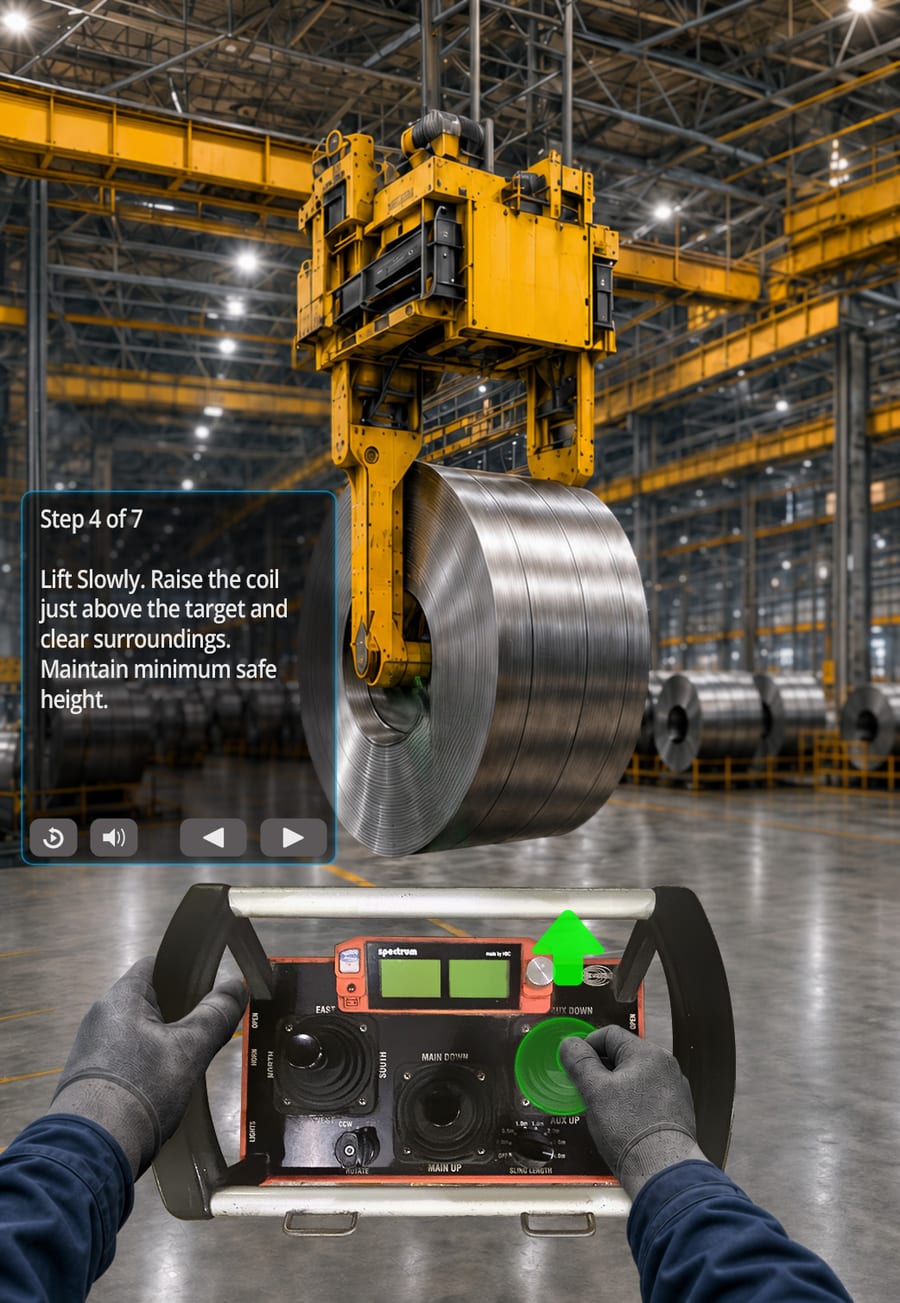
Guided Training Mode provides step-by-step support while the operator learns the coil-handling workflow. The simulator can combine narration, visual prompts, control callouts, highlighted task areas, and corrective feedback to help the trainee understand what action is required and why it matters.
Guided instruction may walk the operator through key steps such as inspecting the work area, confirming the travel path, positioning the crane and coil grab, engaging the coil through its center core, lifting smoothly, transporting the suspended load, avoiding obstacles or unsafe movements, and safely placing the coil at the target location.
Unguided Practice Mode
Unguided Practice Mode allows the operator to repeat the same workflow with reduced assistance. Instead of receiving step-by-step direction, the trainee can practice control use, sequencing, hazard awareness, and placement accuracy with limited prompts available only when needed.
This mode helps operators build procedural fluency and confidence while still working in a safe, repeatable training environment. It also gives trainers a clearer view of how the trainee performs when they are not being led through every step.
Performance Assessment Mode
Performance Assessment Mode removes instructional support and records how the operator performs independently. The simulator can evaluate accuracy, sequencing, control use, visual checks, load stability, swing prevention, placement accuracy, response to hazards, and other safety-related behaviors.
After the assessment, trainers can review a performance summary that identifies completed steps, missed actions, unsafe behaviors, and repeated issues to support trainer coaching priorities. This gives Outokumpu a more objective way to support readiness decisions before trainees move into live crane operation.
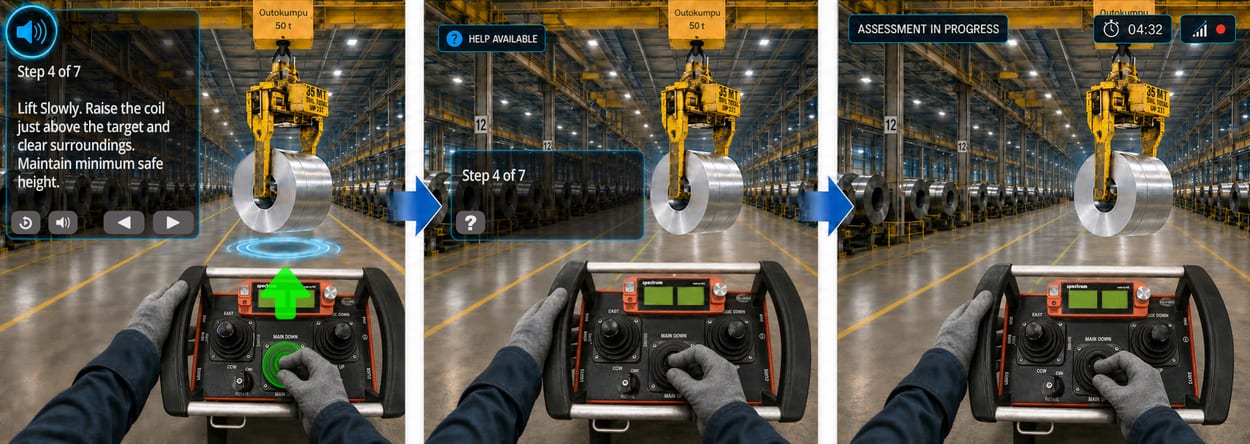
Together, Guided Training, Unguided Practice, and Performance Assessment create a clear path from instruction to repetition to evaluation. This gives operators a safer way to build confidence and gives trainers a more consistent way to measure readiness, reinforce expectations, and identify where additional coaching is needed.
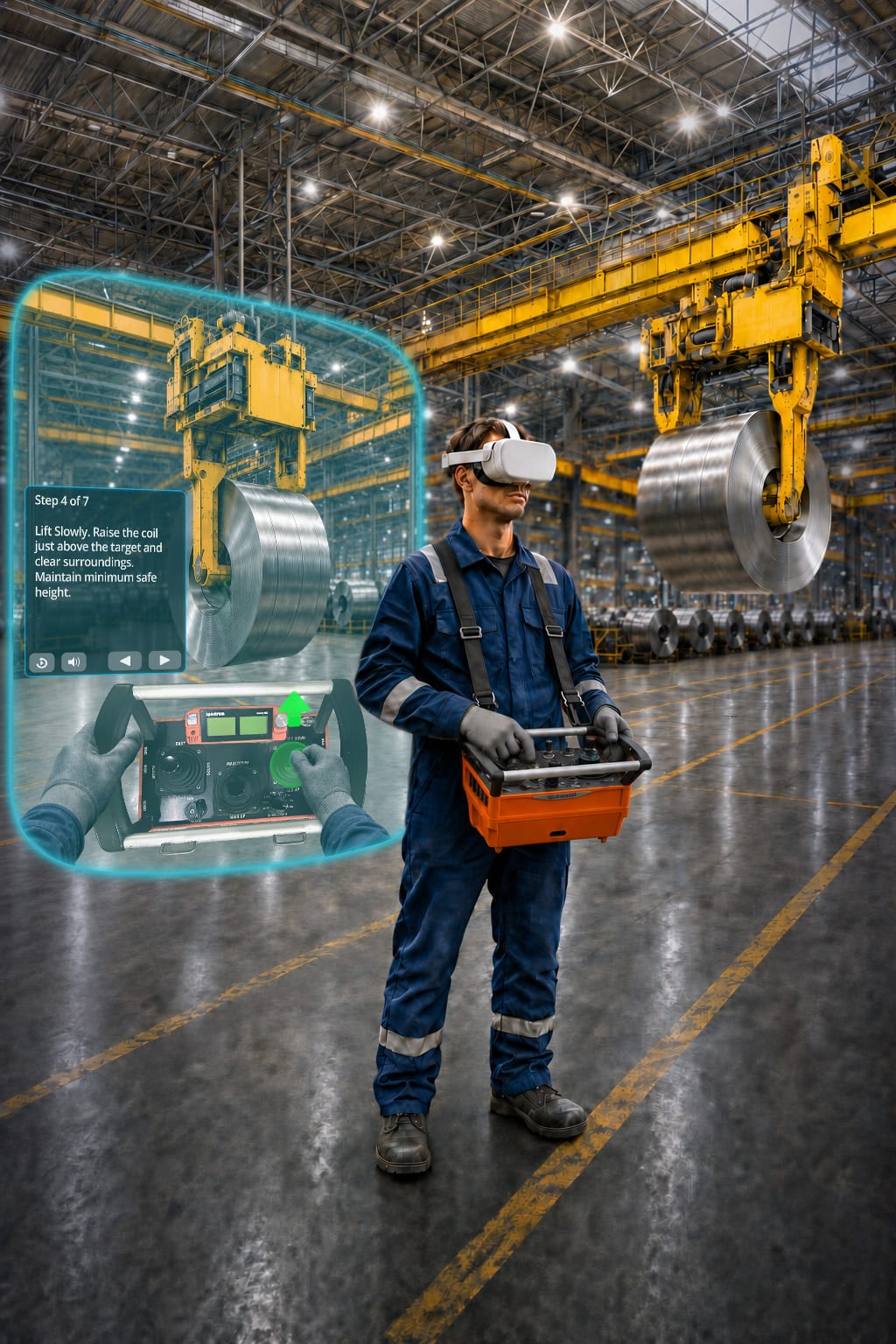
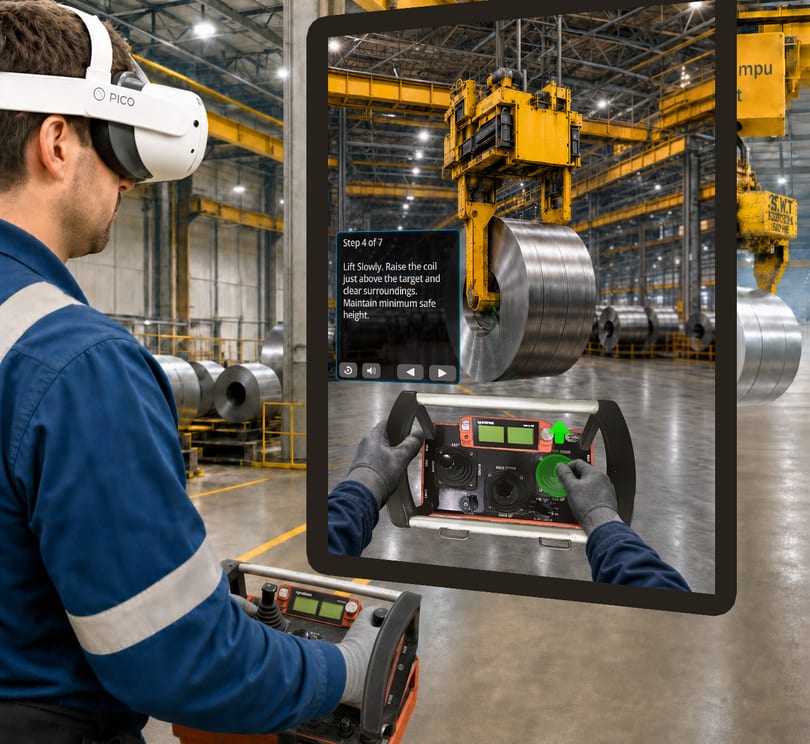
The pilot puts the trainee directly into the training moment. Wearing the VR headset and holding the HBC Spectrum B belly box controller, the operator stands inside a simulated finishing-area environment where the crane, coil, floor markings, travel path, and nearby activity are visible around them.
As the exercise begins, the trainee receives a task prompt and control guidance within the virtual interface. They hear the facility environment, equipment movement, and instructional cues while practicing the sequence of work: orienting themselves, reading the floor, positioning the crane, engaging the coil through its center core, lifting with control, and moving the load toward the placement target.
The experience is interactive and responsive. The trainee sees the crane move overhead, hears equipment feedback as controls are used, watches the suspended load react to movement, and must adjust to drift, swing, visibility, and surrounding worksite conditions. They are not simply reviewing the process. They are practicing the rhythm, timing, and decision-making of crane operation in a safe virtual setting.
The result is a more realistic readiness experience before live-floor exposure, helping operators build confidence in control, situational awareness, and safer coil-handling habits while giving trainers a clearer view of where coaching is needed.
Phase 1: Proof of Concept
Focused VR Crane-Control and Coil-Movement Validation
Phase 1 will establish the foundation for Outokumpu’s Crane Operator Training Simulator through a focused proof-of-concept experience. The POC will allow Outokumpu stakeholders to evaluate the core VR experience, essential crane and load behavior, and one representative coil-handling workflow before expanding into a broader training program.
Phase 1 Focus
Prove the Immersive VR Experience
Establish the ForgeSIM application foundation and allow Outokumpu stakeholders to evaluate the proposed crane-control and coil-movement experience before expanding the training program.
Validate the Essential Operation
Demonstrate how the representative finishing-area environment, crane, coil grab, and load interact to support a focused operator-training workflow.
Complete a Representative Coil Move
Allow users to perform one coil pickup, transport, and placement exercise incorporating selected pre-operation checks, control familiarization, through-core grab engagement, smooth lifting, defined-route transport, and controlled placement.
A Focused First Step with Room to Grow
Phase 1 will give Outokumpu a practical, cost-controlled way to experience the training concept and evaluate its potential. The POC will validate the simulator’s essential equipment, environment, and coil-handling workflow while establishing a scalable technical foundation for the expanded lessons, physical controls, instructional modes, performance reporting, and enterprise capabilities available in future phases.
| Phase 1 POC | |
| ✓ | ForgeSIM Simulation Framework ForgeFX’s immersive-training foundation with scalable architecture supporting future equipment, workflows, training content, records, and deployment needs. |
| ✓ | Essential Virtual Equipment and Environment One overhead crane, inside-diameter coil grab, steel coil, saddle or placement target, and representative finishing-area environment with defined pickup and placement zones. |
| ✓ | 1 Coil-Handling Lesson One coil pickup, transport, and placement exercise incorporating selected pre-operation checks, control familiarization, through-core grab engagement, smooth lifting, defined-route transport, and controlled placement. |
Phase 2: Pilot
Expanded Coil-Handling VR Training Pilot
Phase 2 will expand the initial simulator foundation into a practical VR training pilot for novice and cross-training operators. The Pilot will combine extended virtual equipment and environments, Real-World Controls Integration, three instruction modes, performance reporting, corrective coaching, and four total coil-handling lessons.
Phase 2 Focus
Expand the Training Curriculum
Build on the Phase 1 exercise with three additional lessons, creating a four-lesson progression that gives novice and cross-training operators more opportunities to develop essential coil-handling skills.
Strengthen Operational Realism
Expand the equipment and operating environment to introduce additional attachments, crane configurations, destinations, traffic interactions, restricted areas, and clearance challenges that require greater awareness and control.
Train, Practice, and Evaluate
Use Guided Training, Practice, and Assessment Modes to progress operators from supported instruction to independent performance. Corrective coaching and performance reporting will help reinforce approved processes and identify areas requiring additional practice.
Real-World Controls and Flexible Deployment
Connect the HBC Spectrum B controller to principal crane functions and support training through standalone VR, desktop access, and mirrored instructor view. This combination will provide realistic control practice with flexible options for trainees and instructors.
Phase 2: Pilot Continued
A Practical Pilot for Operator Readiness
Phase 2 is ForgeFX’s recommended option because it offers the strongest balance of practical training value, operational realism, and scalability. It will combine the complete Phase 1 foundation with an expanded four-lesson curriculum, structured instruction, Real-World Controls Integration, corrective coaching, and measurable performance review.
| Phase 2 Pilot Includes the complete Phase 1 POC simulator foundation. | |
| ✓ | 4 Total Coil-Handling Lessons: Includes the Phase 1 lesson plus three additional lessons covering inspection, belly box familiarization, alignment, secure engagement, lifting, transport, hazard awareness, swing prevention, and precision placement. |
| ✓ | Extended Virtual Equipment: C-hook and plate-grab operations, a cab-operated crane, and a virtual representation of the HBC Spectrum B controls module expand the available equipment workflows. |
| ✓ | Extended Virtual Environment: Adds floor markings, equipment, coil-storage locations, saddles, production destinations, pedestrian and forklift crossings, obstacles, restricted zones, and clearance challenges. |
| ✓ | Instruction Modes: Guided Training, Practice, and Assessment Modes support onboarding, cross-training, trainer qualification, refresher training, return-to-work preparation, and post-incident remediation. |
| ✓ | Extended Reality / VR Deployment: Provides standalone VR headset access, desktop access, mirrored instructor viewing, HBC Spectrum B controller integration, and centralized deployment support. |
| ✓ | Performance Summary / Instructor Review: Tracks 20 measures across completion, controls, load handling, placement, safety, inspection, travel quality, clearance, swing, unsafe responses, and stop judgment, with records, histories, notes, pass/fail criteria, and readiness analytics. |
| ✓ | Real-World Controls Integration: Maps 17 key HBC Spectrum B functions, including bridge, trolley, hoist, horn, grab, and principal production-floor controls, with smooth input, drift, swing, and stopping-distance training. |
| ✓ | Voiceover, Prompts, and Corrective Coaching: Includes interface prompts, highlights, instructional narration, corrective feedback, configurable coaching, instructor notes, and curriculum-wide training guidance. |
Phase 3: Core
Expanded Crane Operator Training Curriculum
Phase 3 will include the complete Phase 2 Pilot and add six newly developed lessons, expanding the curriculum from four to ten total lessons. The Core package will retain the established virtual equipment and environments, Real-World Controls Integration, instruction modes, corrective coaching, and performance reporting, applying these capabilities across the expanded curriculum.
With ten lessons, operators will have more opportunities to reinforce essential crane-control and coil-handling skills while encountering a broader range of operating conditions, equipment applications, and material-handling workflows. This added variety will help move training beyond repeated practice of a limited number of sequences and create a more durable foundation for operator development.
Phase 3 Focus
Expand from Four to Ten Lessons
Six additional lessons will extend the training program with new content addressing configurable scenarios, incident recreation, additional attachments and coil types, production-bay and line-feeding workflows, coordinated forklift activity, and wider material-handling practice.
Increase Scenario Variety
Configurable scenarios and incident recreation will introduce varied conditions and decision points, requiring operators to recognize the situation at hand and respond appropriately rather than relying on a memorized sequence.
Broaden Material-Handling Practice
Additional attachments, coil types, production workflows, and coordinated forklift activity will extend training beyond the Pilot’s initial coil-handling curriculum, exposing operators to a wider range of material-handling applications.
Phase 3: Core Continued
Expanded Crane Operator Training Curriculum
The ten-lesson Core curriculum will continue to reinforce the foundational skills introduced in the Pilot, including inspection, belly box familiarization, crane and grab alignment, secure engagement, lifting, transport, hazard awareness, swing prevention, and precision placement.
Six new lessons will extend that foundation into a broader range of scenarios, equipment applications, and material-handling workflows. Operators will have more opportunities to practice interpreting conditions, selecting appropriate responses, and applying established skills across varied training situations.
| Phase 3 Scope Includes the complete Phase 2 Pilot | |
| ✓ | 6 Additional Lessons: Expands the curriculum from four to ten total lessons, creating a broader and more repeatable crane operator training program. |
| ✓ | Configurable Scenarios: Introduces varied training conditions and decision points that require operators to evaluate the situation presented rather than repeat one fixed sequence. |
| ✓ | Incident Recreation: Provides controlled opportunities to incorporate relevant incident conditions into training for recognition, response, and post-incident remediation. |
| ✓ | Additional Attachments and Coil Types: Broadens lesson content to address more equipment applications, load conditions, and coil-handling considerations. |
| ✓ | Production-Bay and Line-Feeding Workflows: Extends training into additional material-movement activities associated with production destinations and line-feeding operations. |
| ✓ | Coordinated Forklift Activity: Adds forklift coordination to the curriculum, increasing the situational-awareness and decision-making demands placed on the crane operator. |
| ✓ | Wider Material-Handling Practice: Expands the range of workflows operators can experience using the established simulator equipment, controls, instructional, and reporting foundation. |
Phase 4: Pro
Connected, Multi-User Training Platform
Phase 4 will include the complete Phase 3 Core package and extend it with LMS / Reporting Integration and Networked Multi-User Training. The Pro package will connect training results to Outokumpu’s designated reporting workflow and support an approved multi-user configuration for up to eight simultaneous participant.
Phase 4 Focus
Connect Training Results
LMS or internal-system integration will connect training records, readiness analytics, and centralized reporting to Outokumpu’s designated organizational reporting workflow.
Enable Multi-User Training
Networked Multi-User Training will support up to eight simultaneous participants, creating opportunities for coordinated training and broader program delivery.
Expand Instructor Oversight
Mirrored instructor views and deployment support will help trainers observe participant activity, oversee connected sessions, and manage training across the approved multi-user configuration.
From Core Simulator to Connected Training Platform
Phase 4 will transform the Core Simulator into a connected training platform built for wider adoption. By adding centralized reporting and multi-user participation, the Pro package will give Outokumpu the strongest foundation for managing training records, monitoring readiness, and expanding crane operator training across its organization.
| Phase 4 Scope | |
| ✓ | Includes complete Phase 3 Core Package |
| ✓ | LMS / Reporting Integration: Connects training records, readiness analytics, and centralized reporting to the designated organizational workflow and supports transfer of approved simulator results. |
| ✓ | Networked Multi-User Training Supports up to eight simultaneous participants, including participant capacity, instructor-view functionality, and the deployment support required for the approved configuration. |
| ID | Feature Title | Feature Description | POC Phase 1 |
Pilot Phases 1-2 |
Core Phases 1-3 |
Pro Phases 1-4 |
|---|---|---|---|---|---|---|
| F-00 | Simulation Framework + Essential Virtual Equipment and Environment | Combines the ForgeSIM simulation framework with the essential virtual equipment and environment package: scalable architecture, one overhead crane, inside-diameter coil grab, steel coil, saddle/placement target, and a representative finishing-area environment supporting the Coil Handling Lesson. | N/A | $277,864 | $277,864 | $277,864 |
| F-01 | Simulation Framework | The ForgeSIM application foundation provides Outokumpu’s crane operator trainer with ForgeFX’s time-tested immersive-training framework and scalable architecture across (5) expansion dimensions: equipment and crane configurations, workflows, training content, training records, and deployment needs. | N/A | $126,375 | $126,375 | $126,375 |
| F-02 | Essential Virtual Equipment and Environment | Essential POC package includes (1) overhead crane, (1) inside-diameter coil grab, (1) steel coil, (1) saddle/placement target, and (1) representative finishing-area environment with pickup and placement zones supporting the Coil Handling Lesson. | N/A | $151,489 | $151,489 | $151,489 |
| F-03 | 1 Lesson (Coil Handling) | One representative coil pickup, transport, and placement exercise with selected pre-operation checks, control familiarization, through-core grab engagement, smooth lift, defined-route transport, and controlled placement. (avg 10 steps per lesson) | N/A | $74,676 | $74,676 | $74,676 |
| F-04 | 3 Additional Lessons | Three additional coil-handling lessons expand practice for novice and cross-training operators across inspection, belly box familiarization, crane and grab alignment, secure engagement, lift, transport, hazard awareness, swing prevention, and precision placement. (avg 10 steps per lesson) | N/A | $224,028 | $224,028 | $224,028 |
| F-05 | 6 Additional Lessons | Six additional lessons broaden the curriculum with configurable scenarios, incident recreation, additional attachments and coil types, production-bay and line-feeding workflows, coordinated forklift activity, and wider material-handling practice. (avg 10 steps per lesson) | N/A | N/A | $448,056 | $448,056 |
| F-06 | Extended Virtual Equipment | Extended equipment package adds (1) C-hook, (1) plate-grab operation, (1) cab-operated crane, and (1) virtual representation of the HBC Spectrum B belly box controls module beyond the essential POC equipment for broader training configurations and workflows. | N/A | $51,699 | $51,699 | $51,699 |
| F-07 | Extended Virtual Environment | Extended environment package builds beyond the essential pickup-and-placement setting with floor markings, equipment, coil storage, saddles, destinations, pedestrian and forklift crossings, obstacles, restricted zones, and clearance challenges for broader training scenarios. | N/A | $80,420 | $80,420 | $80,420 |
| F-08 | Instruction Modes | (3) instruction modes—Guided Training, Practice, and Assessment—support (6) use cases: onboarding, cross-training, trainer qualification, refresher training, return-to-work, and post-incident remediation. | N/A | $80,420 | $80,420 | $80,420 |
| F-09 | Extended Reality / VR Deployment | The XR package provides (3) access and viewing paths—standalone VR headset, desktop access, and mirrored instructor view—plus (1) HBC Spectrum B controller compatibility, within an immersive training environment. | N/A | $15,000 | $15,000 | N/A |
| F-10 | Performance Summary / Instructor Review | Performance reporting tracks (20) measures for completion, controls, load handling, placement, safety, inspection, travel quality, clearance, swing, unsafe-response, and stop judgment. (6) outputs cover records, histories, notes, pass/fail criteria, readiness analytics, and LMS/internal reporting. | N/A | $79,619 | $79,619 | $79,619 |
| F-11 | Real-World Controls Integration | HBC Spectrum B integration maps (17) key controls, including bridge, trolley, hoist, horn, grab, and principal production-floor functions, with smooth input, drift, swing, stopping-distance training, technical hardening, diagnostics, additional crane configurations, and material-handling workflows. | N/A | $137,863 | $137,863 | $137,863 |
| F-12 | Voiceover, Prompts & Corrective Coaching | (7) coaching elements—interface prompts, highlights, instructional narration, corrective feedback, configurable coaching, instructor notes, and curriculum-wide training guidance—support the guided experience. | N/A | $22,977 | $22,977 | $22,977 |
| F-13 | LMS / Reporting Integration | (1) LMS or internal-system integration connects (3) reporting outputs—training records, readiness analytics, and centralized reporting—to the simulator’s reporting foundation, supporting transfer of approved training results into the designated organizational reporting workflow. | N/A | N/A | N/A | $68,932 |
| F-14 | Networked Multi-User Training | Networked multi-user training supports up to (8) simultaneous participants, with mirrored instructor views and broader deployment support. This scope covers the participant capacity, instructor-view capability, and deployment support required for the approved multi-user training configuration. | N/A | N/A | N/A | $206,795 |
| MONTHS | 3 | 6 | 9 | 12 | ||
| 🐢 | v2026.08.03.3 | TOTALS | $85,750 | $1,044,566 | $1,492,622 | $1,753,349 |
The recommended Phase 2 Pilot gives Outokumpu a focused, practical path to improve crane-operator readiness before live-floor exposure. Its four-lesson curriculum combines realistic control interaction, structured instruction, repeatable practice, and performance review, giving trainers clearer insight into operator consistency and coaching needs.
ForgeFX is ready to help Outokumpu turn this opportunity into a production-quality training tool that supports safer preparation, stronger operator confidence, and a scalable foundation for future crane and material-handling training.
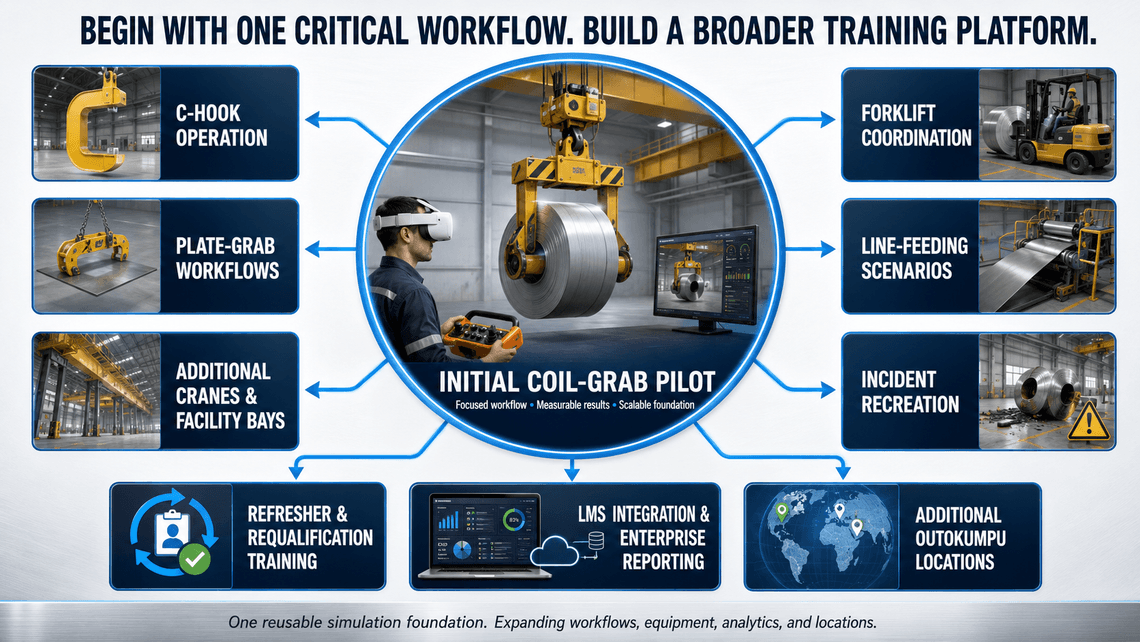
Begin with one critical workflow. Prove the value. Build the foundation.


Scale across workflows, equipment, and locations.
Practice


Enterprise Partnerships

