Bark, Branches, Structure
Convincing trunk and root contact, bark normals, leaf edges, branch junctions, backlit foliage, and canopy interiors. Include distinctive mature specimens plus younger variants. Keep editable source when practical.
 RESEARCH / ENVIRONMENT ART
/Users/forgebot/artifacts/tree-library-research/tree-library-decision-brief.html
Use SpeedTree as the technical benchmark, NatureManufacture as the practical Unity challenger, and a curated asset catalog—not a pile of unrelated tree packs—as the deliverable.
Working assumption: photorealistic, commercial real-time simulation, with Unity the first test path based on historical asset evidence. Unreal, desktop VR, standalone VR, and browser delivery need different validation. The current target engine, render pipeline, hardware, geography, and budget remain open.
Convincing trunk and root contact, bark normals, leaf edges, branch junctions, backlit foliage, and canopy interiors. Include distinctive mature specimens plus younger variants. Keep editable source when practical.
Reduced meshes that retain canopy volume, consistent shading and wind, shared materials, instancing, and smooth transitions. A lower polygon count alone does not prevent expensive leaf overdraw.
Matched billboards or multi-view impostors, then forest-cluster/HLOD representations where appropriate. Preserve canopy density and color. Test elevated cameras and stereo views; a flat card is not a close-up VR tree.
Prefer one coherent tree family across all three tiers. “Hero trees” and “far trees” should not turn into visibly different species when the camera moves. Use screen coverage and the actual camera path to select transitions, not universal distances or arbitrary triangle limits. Unity documents SpeedTree LOD, wind and billboards; Simplygon demonstrates why extreme mesh reduction loses canopy density and a foliage billboard can work better. [1] [2]
Visual references: official vendor screenshots and promotional renders, not ForgeFX benchmarks. Lighting, scene dressing and offline rendering differ; these are not matched quality comparisons. Select an image to open the source image.
Ranked for reusable real-time simulation assets, not offline render beauty alone. Engine-specific branches are alternatives, not a recommendation to buy everything.
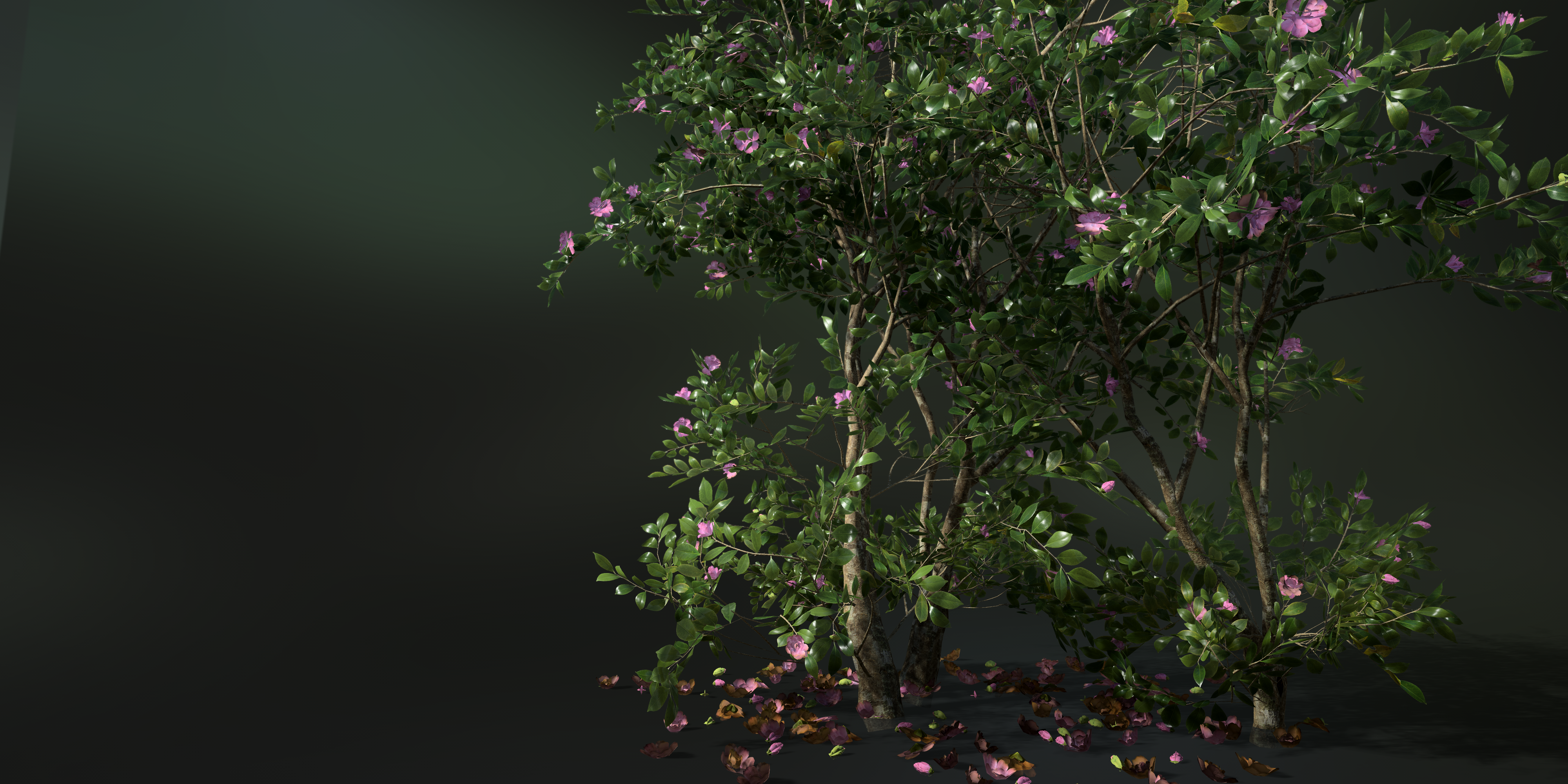
Best fit: a long-lived, editable tree pipeline spanning hero detail, reduced meshes, billboard export and wind. The library is a starting point for controlled variations, not just static meshes. Windows, macOS and Linux Modeler downloads are offered.
Tradeoff: subscription, tier eligibility, and production/reuse terms need more scrutiny than ordinary marketplace packs. Request an Enterprise Games evaluation and quote for client work. Existing engine exports are not the same as editable modeler source.
Advertised: Pro $899/year; Games library add-on $999/year for eligible organizations under $1m. Enterprise: custom quote. Indie $19/month is restricted to the under-$100k tier and is not a safe budget assumption for client simulation work.
Product, current plans and download links · Governing terms · Unity’s SpeedTree 10 demonstration
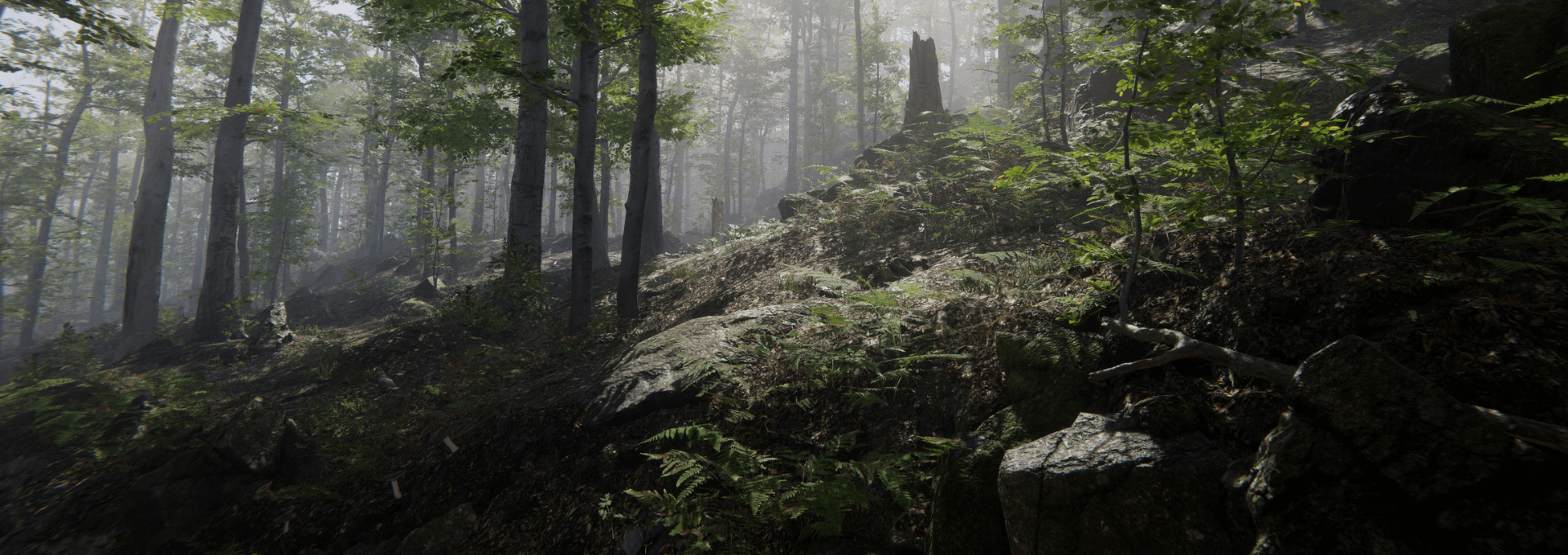
Best fit: ready-made biome packs with trees, companion vegetation, materials and LODs. Forest Environment — Dynamic Nature is explicitly optimized/atlased/LOD-equipped, and its Unity listing marks Built-in, URP and HDRP compatibility across listed versions including Unity 6.
Tradeoff: a biome pack is not a comprehensive global species library or procedural authoring tool. Assess hero trunks and the final cross/billboard transition against the actual scene. Buy the engine-specific product; the publisher links separate Unity and Unreal editions.
Forest Unity listing: $60 displayed; single/multi-entity options, taxes and applicable tier at checkout. Listed release: v1.9.7, 15 March 2026. The old internal Meadow pack is not proof of entitlement to this separate Forest pack.
Publisher details · Unity product and price · Publisher forest demonstration


Best fit: a low-cost, conventional LOD comparison before committing to a premium Unreal forest. Quixel European Black Alder has 22 tree assets, authored LODs, shader-quality tiers, seasonal controls and simple/Pivot Painter wind. It is one species family, not 22 species.
Project Nature’s Spruce Forest offers 15 tree meshes, high/low versions of large trees, shader wind and an optimized distant imposter. Both provide a more concrete near/mid/far starting point than a generic high-poly download.
Both specific Fab listings showed Free. Exact license fields were not exposed in extraction; confirm acquisition terms and engine versions before use. Old Quixel entitlements do not automatically become cross-engine licenses.

Best fit: cohesive, photorealistic desktop environments rather than isolated trees. Meadow Forest supplies full-geometry Nanite foliage, scanned trees/ground assets, custom wind, interaction and procedural biome generation. Redwood and Broadleaf are alternative biome choices.
Tradeoff: the Meadow vendor page requires Nanite, Lumen, VSM, RVT, an RTX 30-series-or-faster GPU and 32 GB RAM. Supplied configuration and shared-library versions matter. Do not treat it as a turnkey mobile, web, forward-rendered VR, or traditional billboard pipeline.
Current eligible-tier checkout price was not verified. Request the exact biome’s Professional price and terms; a marketplace “From” price is not the studio quote.
Meadow specifications and requirements · Redwood · Broadleaf · Vendor walk-through
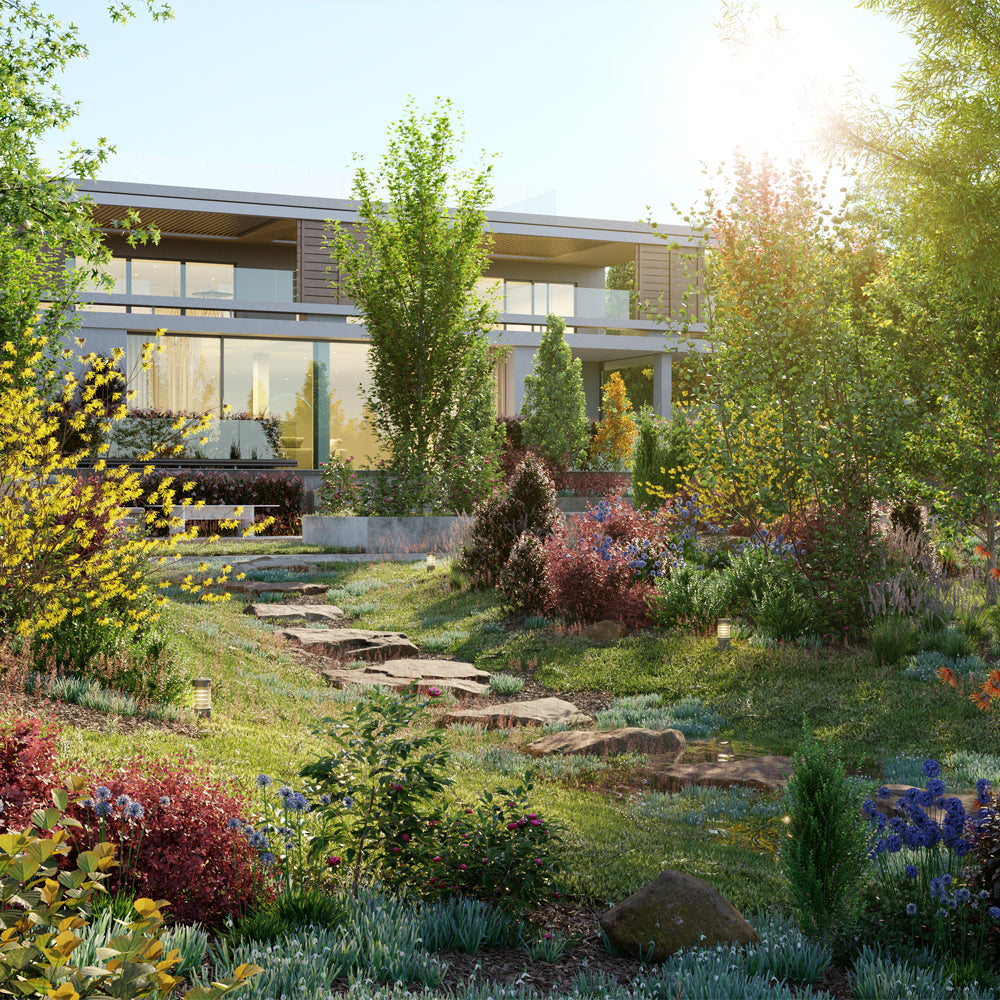
Best fit: acquiring specific regional species or detailed hero specimens missing from the primary library. Catalog formats include FBX and relevant editable GrowFX products. Treat high/low-poly catalog entries as source assets, not a verified complete game LOD chain.
Tradeoff: the vendor’s Unreal tutorial adds materials and wind during import. Budget shader conversion, mesh reduction and far-impostor authoring. Current terms limit final products to non-extractable assets and have unusually broad redistribution wording; get explicit clearance for client source handoff, remote contractors, and web-delivered meshes.
Price depends on exact species, bundle and format; no current purchase quote verified. Buy only to close a proven catalog gap.

Best fit: detailed source vegetation when a technical artist can optimize it. FBX requires material setup; Mesh includes native software packages; GrowFX + Mesh adds original procedural files requiring the appropriate 3ds Max/GrowFX toolchain. Simple Unreal wind is supplied.
Major caveat: Maxtree explicitly says its current products—including low-poly/Unreal formats—are not built to game specifications and textures are not optimized. Its March 2026 EULA requires prior written permission for special fields including military, medical and aerospace, and restricts end-user source delivery.
Format and revenue-tier pricing vary substantially. Obtain an Enterprise/Custom quote for the exact collection and intended simulation use; not recommended as the default bulk purchase.
Formats and game-readiness FAQ · Current license and special-use restrictions · Example tree collection

Best fit: exploring procedural variation and next-generation high-detail vegetation. This is a current product family, not simply the old static Megascans trees renamed. Quixel’s July 2026 announcement confirms free Fab Standard licensing and that future releases target UE 5.8 and above.
Tradeoff: the Procedural Vegetation Editor / Nanite Foliage workflow is marked Experimental in product guidance. Keep it in a separate R&D branch, particularly for headset delivery. Do not replace a proven shipping library solely because the new one is free.
Free under Fab Standard License, explicitly stated by Quixel. Newer engine/plugin requirements and integration work are the real adoption cost.
Quixel announcement, species and license · Common Hazel prerequisites and warning

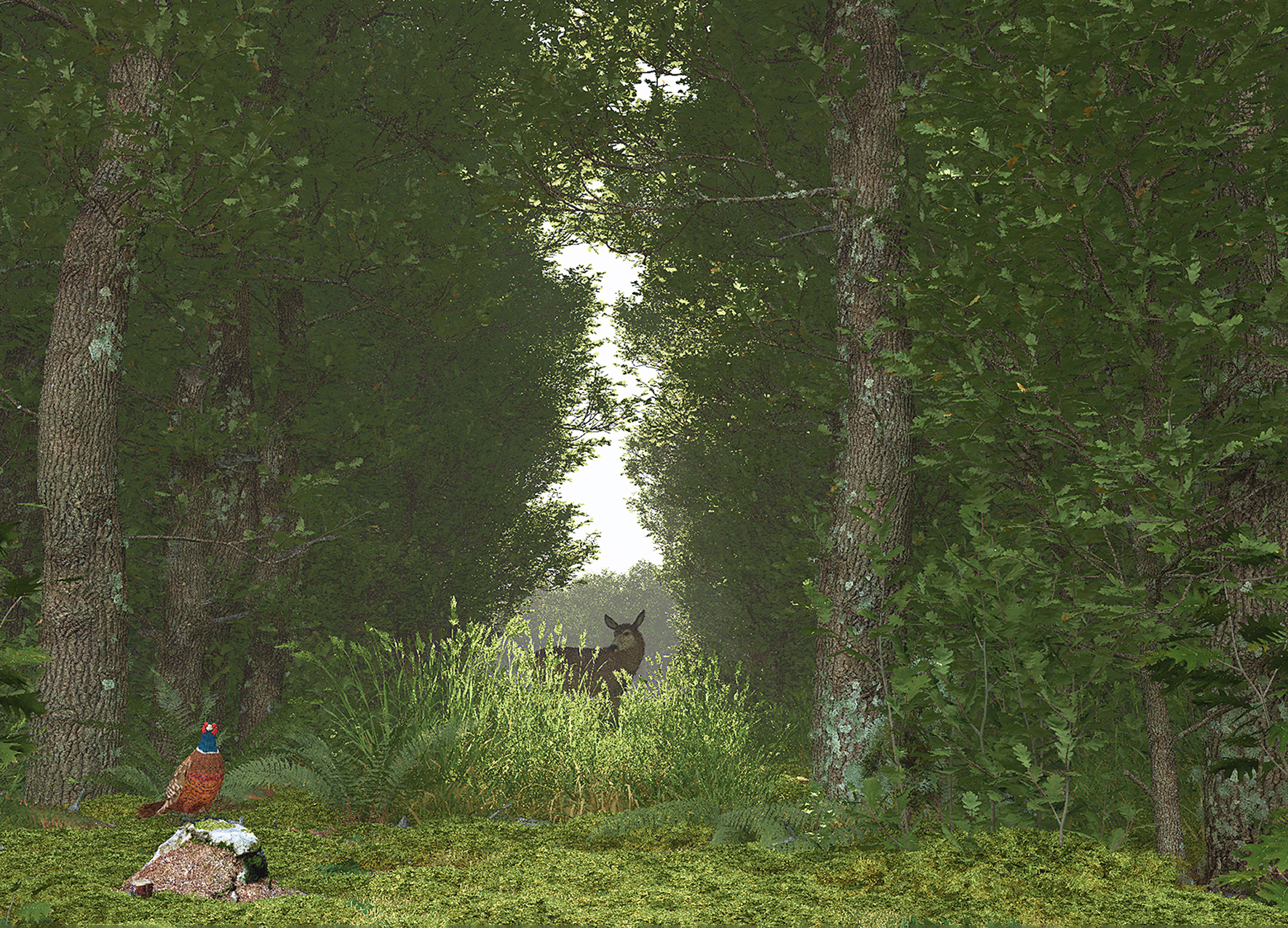
TreeIt: free Windows authoring tool with adjustable LOD and FBX vertex-color wind data. Original user-made models can be sold, but bundled samples have separate restrictions. Engine shaders and integration remain our work; occasional maintenance and legacy dependencies make it a budget option, not a comparable supported library pipeline.
PlantFactory + PlantCatalog: free and commercially usable within Bentley’s terms. 2023 is the final official release; 2024 is unfinished beta. Development is discontinued. PlantCatalog assets can be embedded in games but are not unrestricted resale stock. Useful for controlled offline asset generation; higher long-term maintenance risk.
Free direct downloads. Evaluate labor/support costs before treating either as cheaper overall than a maintained library.
TreeIt features and output permissions · Bentley availability, commercial use and discontinuation FAQ
The Grove offers natural growth and Blender/Houdini workflows, but the vendor says game-engine integration needs manual work; its distribution terms require scrutiny for editable client or browser assets. Evermotion is a selective archviz source rather than our first scalable forest choice; its original UE vol. 4 announcement said there were no tree LODs, and a current replacement LOD chain was not verified. Vegetation Studio Pro is rendering/placement middleware, not a tree library; the current listing is deprecated and unavailable for new purchase.
Common and scientific names · biome · real-world dimensions · age/season variants · source and purchase proof · editable source format · LOD geometry counts · material and texture budgets · wind implementation · colliders · billboard/impostor bake settings · tested engine/pipeline/platform · screenshots and moving-camera capture · performance evidence · allowed client handoff.
Does one agreement cover an internal reusable library used across multiple client simulations? Which staff and contractors need seats? What may ship after expiry, including new projects, updates, paid modules and new platforms? What rights accompany client source-project delivery? Which Games library, source assets, supported versions, and enterprise evaluation exports are included?
Read-only internal research found an archived tree testbed with SpeedTree City Park and NatureManufacture Meadow content, including hero/desktop model naming and billboard textures. Its recorded editor is Unity 2019.4.15f1. The repository tree contains 33 .st files—plant, season, and model variants, not 33 tree species. Presence in a repository does not prove current license entitlement, complete binary assets, or compatibility.
Historical technical-art notes identify LOD transitions, foliage normals, material settings, instancing and color matching as recurring integration concerns. That supports testing complete moving-camera scenes rather than ranking product beauty shots. One project’s historical single-LOD workaround is not a general forest recommendation.
Internal evidence was checked through Slack and live GitHub metadata/file paths. Fireflies keyword searches did not yield a verified relevant library decision; a matching production meeting contained only incidental vegetation discussion. A private one-on-one result was excluded. Internal source links and raw details remain in the local evidence note rather than on this link-accessible report.
Verified: linked public product documentation, advertised prices where obtainable, written license conditions, and the existence of an older internal asset testbed. Not yet verified: checkout completion, current organizational entitlements, customer-specific contract terms, imported asset quality, LFS payload recovery, or runtime performance. Vendor feature claims below are documentation-based; rankings are recommendations, not measured benchmark results.
Coverage combines official vendor pages, engine documentation, license documents, a specialist optimization article, public code, and bounded internal Slack/GitHub/Fireflies research. Public video links are included as vendor demonstrations, not independent quality tests. No paid model-research APIs were used. Prices are snapshots before tax and may differ by currency, tier, promotion, or account.
Prepared 17 September 2026 · This page contains a sanitized internal summary and public-source research. It is link-accessible, not authenticated. No asset purchases, installations, migrations, or engine benchmarks were performed.